Lake Lure Water Sample Reports 2026

Department of Environmental Quality - Water Quality Samples 7/22/26
The water quality sample collected at the Lake Lure Swim Beach on 7/22/26 by the Department of Environmental Quality has been posted to our dashboard and appears to be consistent with historical results which are within acceptable limits.
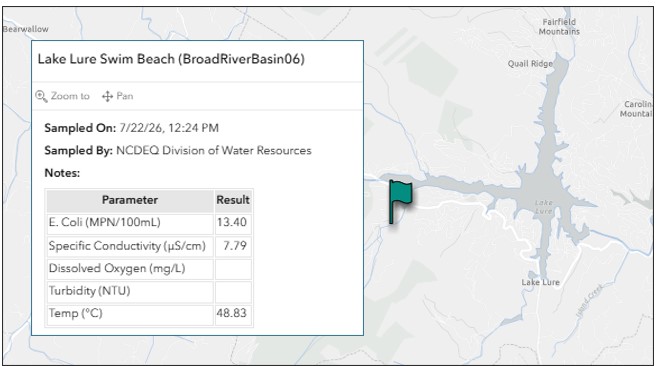
Western North Carolina Recreational Monitoring Program Dashboard
Additional Water Quality Testing
The Town of Lake Lure works with Environmental Quality Institute and also Clear Water Lab to sample the water at the Broad River (above Lake Lure), and throughout Lake Lure, and at the Lake Lure Dam.
Clear Water Lab Notes:
- MCL is EPA’s maximum contaminant level under primary drinking water regulations.
- Sample received and examined within EPA’s recommended holding time.
- Results in BOLD exceed the EPA’s Primary MCL.
- ND - Not Detected at the corresponding reporting limit.
- NA - Not Applicable.
- Analytical method: IDEXX Colilert Test Kit; IDEXX Colilert Test Kit using IDEXX Quanti-Tray/2000
- We certify that the analyses performed for this report are accurate, and that the laboratory tests were conducted by methods approved by the US Environmental Protection Agency and the NCDHH.
June 2026
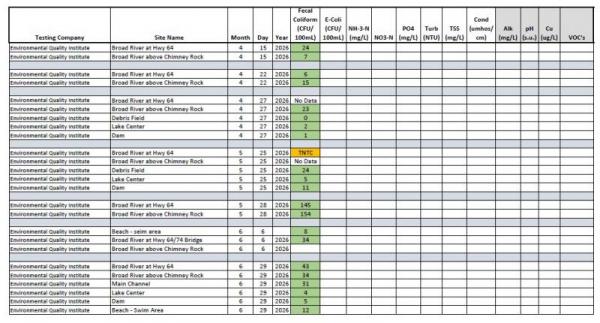
Please see the attached water sample results through June 2026. We are pleased to report that the latest results are all within acceptable limits.
- You may review the spreadsheet, which illustrates all the water sample data received by the Town of Lake Lure.
- Orange or yellow highlighted cells indicate high results.
- This data is current through 6/29/26 and the updated report was received 6/30/26.
You may read a more detailed summary of recent test results here.
For questions, please email Communications@townoflakelure.com
Additional Information from the Department of Environmental Quality
"The North Carolina Department of Environmental Quality Division of Water Resources (DWR) provides E. coli data through the Western N.C. Recreational Water Quality Monitoring Program to help the public make informed decisions before recreating in or on a waterway. The results are available online through our dashboard, and they are also posted on Swim Guide. The public can check the data to find sites where E. coli values are above or below the recommended level for secondary recreation such as kayaking (886 CFU/100 mL) and for primary recreation such as swimming (126 CFU/100 mL). DWR is conducting sampling weekly from May to September, including at Lake Lure.
Please note water quality can change rapidly alongside changes in conditions such as water flow, sediment load and temperature. These changes are commonly impacted by rain events and associated stormwater runoff. It is always advised that the public follow North Carolina Department of Health and Human Services (NCDHHS) guidelines when recreating in natural waters. NCDHHS is the agency charged with issuing health and (or) recreational advisories in North Carolina. Contact NCDHHS or your county health department to stay up to date on water quality advisories for recreational waters. NCDHHS has recommendations for recreational water safety online.
The public is encouraged to report any water quality issues to the DWR Asheville Regional Office, or using DEQ’s anonymous comment tool. For questions about the WNC Recreational Water Quality Program, please reach out to Laura Oleniacz, public information officer for the Division of Water Resources, at laura.oleniacz@deq.nc.gov. More information is also available about the program online.
DWR's Asheville Regional Office launched the WNC Recreational Monitoring Program in 2019 in order to help advise recreational users of natural waterways in the region by providing water quality data assurance and quality control for partner organizations conducting water sampling, as well as support in data sampling and data analysis.
For additional questions or suggestions, please contact Communications@townoflakelure.com
Supporting Documents
 2026 Water Quality Sample Report (309 KB)