Summary of Water Quality Samples in Lake Lure - June 9, 2026

Summary of Water Quality Samples in Lake Lure
June 9, 2026
The Town of Lake Lure works closely with the NC Department of Environmental Quality (NC DEQ) and the Environmental Quality Institute in Black Mountain for ongoing water quality testing.
-
Water samples have been routinely taken in Lake Lure weekly since October of 2024, following Hurricane Helene, as well as prior to the storm.
-
The results of these tests are posted monthly on the Town of Lake Lure website when they are received from Environmental Quality Institute.
-
The Environmental Quality Institute water quality sample report for April 2026 was posted on May 11, 2026, when it was received. All results were within normal limits.
The following is a timeline of what transpired beginning 5/27/26 as it related to water quality in Lake Lure.
-
There was a draught in the area in May 2026.
-
During Memorial weekend in late May 2026, a stalled weather front dumped an astonishing 7 to 10 inches of rain overnight on parts of the Hickory Nut Gorge, particularly around Bat Cave and Gerton.
-
This torrential downpour caused severe flash flooding, washed out driveways, and triggered additional road damage.
-
The spreadsheet shown below illustrates the impact of that rain on the May 28, 2026 samples, as compared with the previous month’s results.
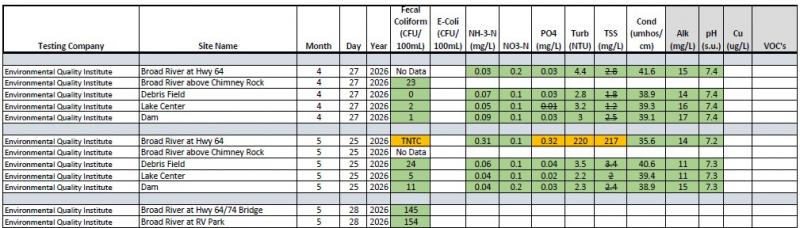
Note: The results shown above are from the organization the Town of Lake Lure uses for water quality testing, the Environmental Quality Institute. Multiple entities in North Carolina test for water which is a good thing. The results of these tests may vary day-to-day based on conditions at the time. The results from the above from Environmental Quality Institute are updated on the Town website monthly.
Thursday, June 4, 2026:
-
Once of the additional water quality testing entities is the NC DEQ. Lake Lure’s Town Manager and Public Services Director received an email message from NC DEQ, notifying them of the results of a water sample that they had taken from Lake Lure on June 3, 2026. Their message indicated that the sample showed an elevated E.coli of 488. The notification recommended the area be resampled.
-
The Public Services Director made arrangements for the water to be retested.
-
Note that this water sample was through DEQ and is separate from Lake Lure’s routine water sampling process through Environmental Quality Institute.
-
This sample measured E.Coli.
-
The Environmental Quality Institute’s monthly test is comprehensive and they notify the Town of Lake Lure if any limits are out of the ordinary, which is extremely rare.
Friday, June 5, 2026:
- Water in the Broad River above Chimney Rock and at the Lake Lure Beach was retested.
Saturday, June 6, 2026:
- Public Services Director received notification from the Environmental Quality Institute with the results noted below, confirming that the issue was resolved. (See the testing results for June 6, 2026.)
Sunday, June 7, 2026:
- The Lake Lure Beach Manager advised that she had received inquiries regarding the water quality.
-
Communications Director reached out to the Town Manager and Public Services Director to request the latest water quality samples so these could be posted.
-
The water quality sample report through May 2026 as well as an email with the results from the June 6, 2026 testing was forwarded.
-
Water quality samples, including the June 6, 2026 samples were posted on the Town website and shared on the Town’s Facebook page with the following update provided by Environmental Quality Institute.

Monday, June 8, 2026:
-
The Environmental Quality Institute forwarded the updated water quality samples report, including the samples taken June 6, 2026,
-
This updated water quality samples report was posted in the Town’s website in Town News.
-
In discussing the recent data with Ann Marie Traylor, Executive Director for The Environmental Quality Institute, she provided the following additional information.
“I understand there are some concerns about bacteria levels in Lake Lure. EQI has been partnering with the Town through the Volunteer Water Information Network since 1996, so we have a long history of water monitoring in the watershed. The town has typically tested for fecal coliform monthly at certain locations during the warm months. Fecal coliform has a long-standing regulatory limit in NC for fresh surface waters, and we have two decades of baseline data. The timeframe for analysis using membrane filtration is up to 8 hours from sample collection to incubation, followed by 22-26 hours of incubation prior to counting the bacterial colonies.
EQI tests samples from 14 WNC counties, brought by many regional partners to our nonprofit lab in Black Mountain. MountainTrue, along with other nonprofits and local governments, test weekly for E. coli in recreational areas throughout WNC. Fecal coliform and E. coli tested from water collected on the same day MAY have similar levels, but they are not the same and will not usually be equal. I find that having different organizations involved in water quality monitoring is exciting and beneficial for painting a picture of water quality in the whole region.
Here is an example of what I see as typical fecal coliform levels in WNC. Last week, EQI analyzed 19 sites from Haywood, Jackson, Buncombe, and Rutherford Counties for fecal coliform. The results from those samples ranged from 16 to 4,100 colony-forming units per 100 mL (CFU/100mL). Unfortunately, it's not unusual for us to see results in the tens of thousands. Sometimes follow-up testing shows that it was transient, and sometimes it's a chronic problem. To me, results in the low hundreds are worth notice and continued monitoring but are not unexpected in natural waters in this area, especially after heavy rainfall in the watershed.”
David Caldwell, Broad Riverkeeper who reports data for the Swim Guide, provided the following additional information.
“Basically, if a site fails the criteria for safe swimming, and we post that on the Swim Guide site and social media, we are not telling people to "stay out of the water". We are informing the public that there is potentially a high level of bacteria in the water and that they need to use this information to determine their options and make decisions based on the risks they may be taking.
Here's a key point to emphasize. The safe swimming criteria that NCDHHS recommends is based on: " Recreational ingestion rates reflecting the upper confidence levels of 140 mL per hour for the primary (swimming) ingestion value,"
That means they are assuming that the average person will drink over a half a cup of the water they are swimming in, every hour. So, if I go swimming and keep my mouth closed, being careful that I'm not ingesting the water, I'll be safer for a much longer duration.”
Additionally, the Department of Environmental Quality provided the following additional information.
“The North Carolina Department of Environmental Quality Division of Water Resources (DWR) provides E. coli data through the Western N.C. Recreational Water Quality Monitoring Program to help the public make informed decisions before recreating in or on a waterway. The results are available online through our dashboard, and they are also posted on Swim Guide. The public can check the data to find sites where E. coli values are above or below the recommended level for secondary recreation such as kayaking (886 CFU/100 mL) and for primary recreation such as swimming (126 CFU/100 mL). DWR is conducting sampling weekly from May to September, including at Lake Lure.
Please note water quality can change rapidly alongside changes in conditions such as water flow, sediment load and temperature. These changes are commonly impacted by rain events and associated stormwater runoff. It is always advised that the public follow North Carolina Department of Health and Human Services (NCDHHS) guidelines when recreating in natural waters. NCDHHS is the agency charged with issuing health and (or) recreational advisories in North Carolina. Contact NCDHHS or your county health department to stay up to date on water quality advisories for recreational waters. NCDHHS has recommendations for recreational water safety online.
The public is encouraged to report any water quality issues to the DWR Asheville Regional Office, or using DEQ’s anonymous comment tool. For questions about the WNC Recreational Water Quality Program, please reach out to Laura Oleniacz, public information officer for the Division of Water Resources, at laura.oleniacz@deq.nc.gov. More information is also available about the program online.
DWR's Asheville Regional Office launched the WNC Recreational Monitoring Program in 2019 in order to help advise recreational users of natural waterways in the region by providing water quality data assurance and quality control for partner organizations conducting water sampling, as well as support in data sampling and data analysis.
The Town of Lake Lure is working closely with all of these organizations to test and ensure the highest water quality.
For additional questions or suggestions, please contact Communications@townoflakelure.com